 |
| 寄件者 MArch_Term 03 |
 |
| 寄件者 MArch_Term 03 |


|
Tze-Chun Wei |
UCL, M.Arch(Dist.) NCKU, BSc. in Arch. dotze innovations studio |
 |
| 寄件者 MArch_Term 03 |
The project is about shifting points and vectors in a landscape, the basic description of a geometry is a point, and a vector describe the intention of movements and forces. The shifting of the vector illustrate the pulsation that alter the movement, the factor which alters the point to change its position. The vector field is the description of the movement in the field and sum as a trajectory to indicate the path of the movement. Traces are the indexes of describing the past, the moment when vector is shifted and left imprint on the surface during the drifting of a point, it is the evidence of the shifts in the landscape.
From this point of view, looking back to the topography of the defence trenches, it is a continues shifting landscape of the two conflicting forces. The forces that alter the border of the defence and leave the imprint of the shifts on the site, such as the bomb craters, torn building, cut down trenches. The bunker in this site plays the role of strong front as a point in the landscape, the gun fire line from the embrasure act the force as a vector in the landscape, the vector field is a series of bunkers that form the defence border line which is continues shifting, the shifting territory make traces inside the bunker, the space that capture the arrival of the conflict forces.
The lefted bunker is the empty vector space waiting for the arrival of the forces which is no longer bomb or missle, but the opening of the embrasure still exist where exterior disturbances are comming through. The vector calibrating device inside the bunker is capturing the disturbances and adjusting the position of the embrasure, it is transmiting the factors into pulsation to alter it's vectors, the vectors of bunker then alter the border of defence to shift and left new imprint on the landscape as marks of the shifting vectors in a landscape.
 |
| 寄件者 MArch_Term 03 |
The dragsaw topology is the idea of the shifting trenches that been build during the wartime as defining the border of defence, the trenches continues shifting due to the invasion of the enemy, the two forces that drag and drift the border on the landscape. This can be seen as a buffer zone between the two, the intermediate space that is shifting due to the exterior factors.
The embrasure is the opening of the dark bunker, it is the intermediate space of the offence and defence, and it is the slit where two forces collides, my design will locate in this territory where the two factors are pulling and dragging each other, the and recording the trace of the conflict as the dragsaw topology map to describe this space.
 |
| 寄件者 MArch_Term 03 |
 |
| 寄件者 MArch_Term 03 |
 |
| 寄件者 MArch_Term 03 |
Testing the idea of the blitz geography, the blitzed landscape that destructed in the wartime by the bomb explosion, the scattered land and debris split around the crater. The missle trajectory and the trace of the shiting landscape recorded on the surface as an archeological layer that been covered by dust and occupied in the crevice.
 |
| 寄件者 MArch_Term 03 |
The plastic surface start to form the funnel shape that records the trace of the bullets hitting on the wall, the recorded occurred trajectories.
 |
| 寄件者 MArch_Term 03 |
The sun light comes through the slit and deflected by the reworked surfaces that generate the distorted light reflections inside the dark bunker as the projected swerved trajectories.
 |
| 寄件者 MArch_Term 03 |
The rain dropping from the curved plastic surfaces and mixing with the dust particles as dirty rain falling inside the bunker, the trace of the rain left mark on the wall and the muddy floor that makes the bunker as an alienation landscape, the destructed surfaces that become uninhabitable.
|
| 寄件者 MArch_Term 03 |
Bunker is a discussion about the exterior and interior boundary that is shifting due to the influences on both territory. The landscape of wartime that is shifting its border in between two sides. The embrasure is the gap where both influences are interweaving. Using light, dust, trace as methods for mixing the factors inside the bunker.
This is the first tryout of the reflecting light inside the dark bunker, using the heating gun to deform the plastic sheet and form the funnel shape on the surface as reflecting surfaces, the plastic material remembers the destructing force that creates the shape, it is the simulation of the bullet hit on the wall and make a concave surface. The surface then become a lens for deflecting the light that coming through the embrasure, the slit of light inside the dark bunker is deflected as distorted projections. The wax poured on the curved surface is the simulation of the dirty rain dropping onto the floor and leave traces on the ground. The wax on the plastic sheet causes shadow inside the bunker as memorizing the destructing forces from the exterior.
 |
| 寄件者 MArch_Term 03 |
 |
| 寄件者 MArch_Term 03 |
 |
| 寄件者 +Day02_Berlin |
 |
| 寄件者 +Day02_Berlin |
This is the photo taken in Berlin, a wall of bullet holes in WWII, it was used as a machine gun fortress during the war, and now it is an art museum. The wall itself is an art piece, a piece of memory of the wartime. The bullet hole is a destructed landscape, the aftermath during the collision and impact. It is the trace of the past of the projectile destination. This is what I'm interested in, the aftermath destructed landscape, a landscape of traces. It is the same quality of the falling leaves, bunkers, footprints, the evidence of geometry shifs in a space. My problem is what can I do with this? It is still a phenomenon, how to become an architectural system that is applicable?
Readings ( Spring / Summer 2008)
Inspired by the culture of sun worship and the cult of celebrity, the showpiece of the collection consisted of two dresses, a jacket and a hat containing Swarovski crystals and over 200 moving lasers, a technology not previously used by Chalayan. The lasers are held in place by custom-made hinges which move by motors. This trains the lasers first on the crystals before moving away from the body creating a matrix of red laser light. The graphical rays represent the aura of performance, with the light space becoming an alternative form of spectacle.
 |
| 寄件者 +Exb_Hussein Chalayan |
I'm thinking of using this idea of laser beam as the way of constructing the trajectories inside the bunker, the beam reveals only when the bunker is full of dust, the foggy volume that shows the beam of light. But a little adjustment here is the way of bending a laser beam that makes swerved laser instead of a strait one. Water could be a good idea of distorting the laser beam. The light that swing inside the empty bunker.
 |
| 寄件者 MArch_Term 02 |
 |
| 寄件者 MArch_Term 02 |
My project become a crossroad, is dust matters? or particle matters?, where should I position my dust in my project, is it just a phenomenon effect a memory dust?, is it important what kind of dust or where does it comes from? Is it the dust falling from a sculpture by Bernini that indicate the motion of the figure? or it is the dust inside the bunker where all the debris covered inside during the wartime. I'm not sure right now, but the warfare and bunker interests me a lot.
This is just a very simple idea, using a tape to trap the dust around the space from different location, as result shown that the dust aggregates around the corner where can trap more dust. I'm thinking of a dust map recorder then can playback like a film, a pattern of displaying the different condition of the dust occupation. But can dust express the events by just looking at the pattern? It seems a way too idealist.

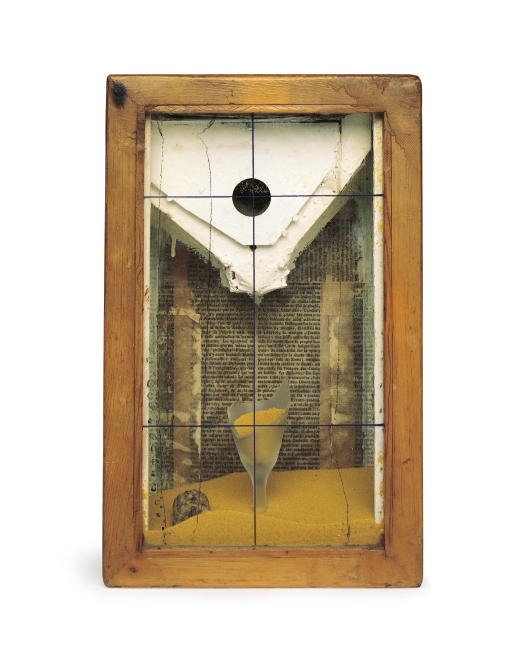
In the simple tumble of sand from the top of Sand Fountain into a broken glass, echo memories of egg timers, of Victorian sand toys, of penny arcades. This work combines fun and fatalism. The finite amount of sand implies a finite amount of time, making Sand Fountain a modern vanitas, a reminder of our mortality. This is emphasised by the fragility of the glass, which stands broken, a cracked vessel incapable of truly capturing the fleeting sands of time. This appears to be a metaphor for life, but it is one in which Cornell asks the viewer to participate. Works such as this bring the importance of the viewer's physical interaction with Cornell's works to the fore. We are required to become involved with this box, to do more than merely view. Cornell designed Sand Fountain to be taken from its place, turned upside down in order to recharge the compartment at the top, and then tipped once more in order for the sand to fall down again. We are meant to contemplate it, but also to play with it. It is no coincidence that Cornell once even had an exhibition of his works that was designed specifically for children. A childlike wonder is at work in this box, as well as a poignant poetry.
Here we truly see the embodiment of Cornell's own description of his boxes:"Perhaps a definition of a box could be as a kind of 'forgotten game,' a philosophical toy of the Victorian era, with poetic or magical 'moving parts', achieving even slight measure of this poetry or magic...that golden age of the toy alone should justify the 'box's' existence" (J. Cornell, quoted in D. Ades, "The Transcendental Surrealism of Joseph Cornell," pp. 15-41, Joseph Cornell, exh. cat., New York, 1980, p. 29).It is only too apt, considering the central theme of time's passage in Sand Fountain, that Cornell has made it so evocative of days of yore. Cornell conjures a deliberately antiquated atmosphere by including opaque, broken glass, which appears frosted with time, and also the antique page of French text that papers the back. This links Sand Fountain to the past, to Cornell's beloved French culture and literature, to travel, to his friend Marcel Duchamp -- in short, to his own personal memories. Sand Fountain therefore comes close to crystallizing and capturing, behind glass like some specimen, the intimate and the ineffable.

 |
| 寄件者 MArch_Term 02 |
 |
| 寄件者 MArch_Term 02 |
孫子兵法-行軍篇第九
眾樹動者,來也﹔
眾草多障者,疑也﹔
鳥起者,伏也﹔獸駭者,覆也﹔
塵高而銳者,車來也﹔
卑而廣者,徒來也﹔
散而條達者,樵採也﹔
少而往來者,營軍也。
The Art of War, Sun-Tzu
If birds start up, there are ambushers there.
If the animals are frightened, there are attackers there.
If dust rises high and sharp, vehicles are coming;
if it is low and wide, footsoldiers are coming.
Scattered wisps of smoke indicate woodcutters.
Relatively small amounts of dust coming and going indicate setting up camp.

 |
| 寄件者 MArch_Term 02 |
 |
| 寄件者 MArch_Term 02 |
 |
| 寄件者 MArch_Term 02 |
 |
| 寄件者 MArch_Term 02 |
I am looking for the programme of my project might head to, it's about motion object, trajectories, shifting landscape. By looking dust as the evidence of object in motion and the landscape of trajectories, the trace that left behind by movement. Accidentally I was looking for the book written by Paul Virilio, to have some idea what the event actually is, since I was using these terminology. I found an interesting article of photos, "Bunker Archeology", it's about the bunker that was build during the WW2, the architecture now was abandoned and left on the site, the pure structure with exposed concrete, and it is build as a shelter for weapons and soldiers.
What I extent here is the pure function is now erased, but the trace of the war time still exist. The mark of the bullet or cannon shell left on the wall, the raised dust that covered on the surface when bomb of explosion occurred. The soldier stepping on the surface of sand, the tank squashing the land and carrying dirt over different destination. It's the geometry of the landscape that is relocating due to the events happening on the site.


